Culture Doesn’t Happen Live Anymore
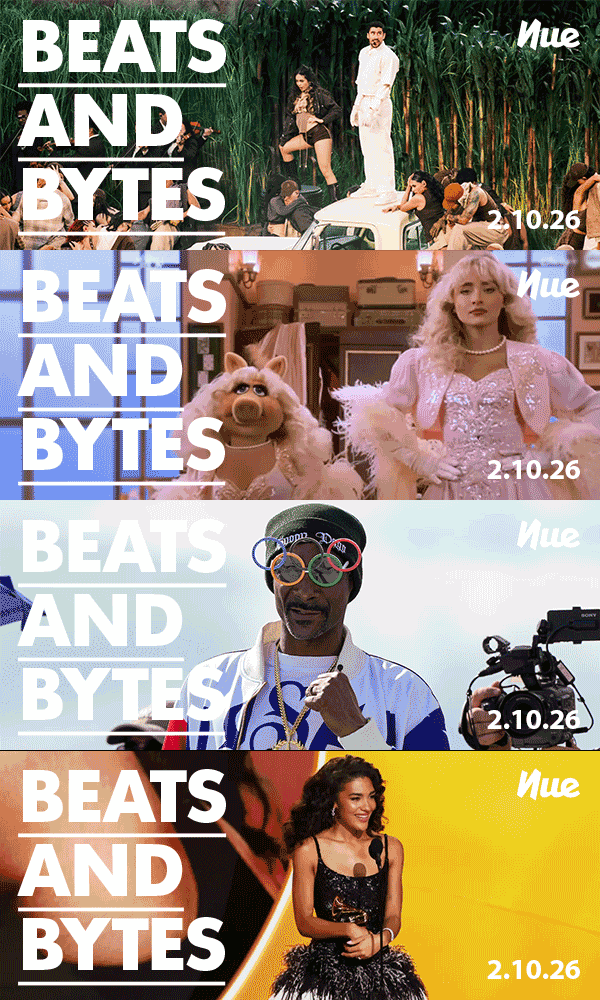
Mainstream culture doesn’t happen live anymore. It happens in the aftermath.
What an interesting week for content.
Beyond the Benito Bowl – where the shared emotion of the performance and watching it live together felt like the biggest play of the game, everything else was… kind of meh?
Until after the game, that is. That’s when it actually got interesting.
The commentary. The memes. The coded explanations. The group chats. The screenshots. It was loud, chaotic, coming from all angles, extremely informative and completely un-uniformed. Everyone has an opinion about this one… The curatorial art form was in synthesizing, connecting the dots, reading the tea leaves, understanding the data and hearing first hand accounts of what actually happened; not just culturally, but commercially.
As a cultural anthropologist, that’s where the value gets unlocked. As a marketer and dealmaker, those insights are priceless.
This was the first year the memes were better than the commercials, and the surrounding commentary was more impactful than the event itself. The real action wasn’t on the field or on stage; it was at the pre-game events, in the war rooms, behind-the-scenes clips, making-of moments, and deeper symbolism being decoded in real-time.
The big music moments all shared a common thread: samples, covers, and reinterpretations. This was clear proof that the catalog business isn’t just alive, it’s thriving. Cultural memory is outperforming novelty and the more creatively you tap into nostalgia, the more value there is to unearth.
My favorite spot was the Dunkin’ Donuts commercial. The nostalgic return of all those ’90s stars had me genuinely unsure what I was even looking at. Were they real? Were they AI? Was it a hybrid?
This led me to a bigger question, one we’re all going to have to answer soon: Do people even care if it’s real anymore, or only if it feels good to watch?
Is the rate to book a star’s AI image and likeness different from a traditional service day? Does a heavily CGI’d version carry the same value as the real person? Is it “just IP” now, infinitely remixable, licensable, and scalable?
The lines blurred on Sunday night and the future is being written through case studies like this.
What also stood out is how many of the AI commercials were playing with past eras of the internet. AI is an incredible, exciting set of tools that’s revolutionizing every facet of culture. Anyone actually using this technology knows the feeling — we’re all becoming superhuman versions of ourselves. The breakthroughs are mind-blowing, but much of this moment is still about doing things better, faster, and more efficiently.
Not unlike surround sound elevating the impact of the Super Bowl broadcast, AI is, at present, more acceleration than invention. Its current landscape is more generative than anything else.
Meanwhile, just outside the stadium in the SF dive bars and loft offices, the energy around Clawbot, Moltbot (despite being outed as rigged through human intervention), and the nonstop release of new features feels more exciting than almost anything happening in pop culture. It’s reminiscent of the Web 2.0 era when meetups between builders and early believers had us all imagining what comes next.
But it also feels fundamentally different. The stakes are different. The rules are different. The velocity is different.
And the biggest difference? Culture is no longer driven by moments, it’s driven by interpretation.
As we are constantly moving toward new heights, the big keep getting bigger. There are new frontiers, new models, and new opportunities being configured. But it’s clear there’s a cultural gravitational pull toward nostalgia. What we’re really seeing aren’t “new ideas,” but endless interactions and reinterpretations of familiar ones, remixed to help us make sense of a world that’s changing faster than our instincts can track.
The brands and artists that will win aren’t the ones chasing attention in real time, they’re the ones who understand how meaning forms after the fact. That’s where strategy needs to live now because that’s where leverage is created. Culture collectively decides what matters through fragments, echoes, and feedback loops.