The Music Business Has a New Music Problem
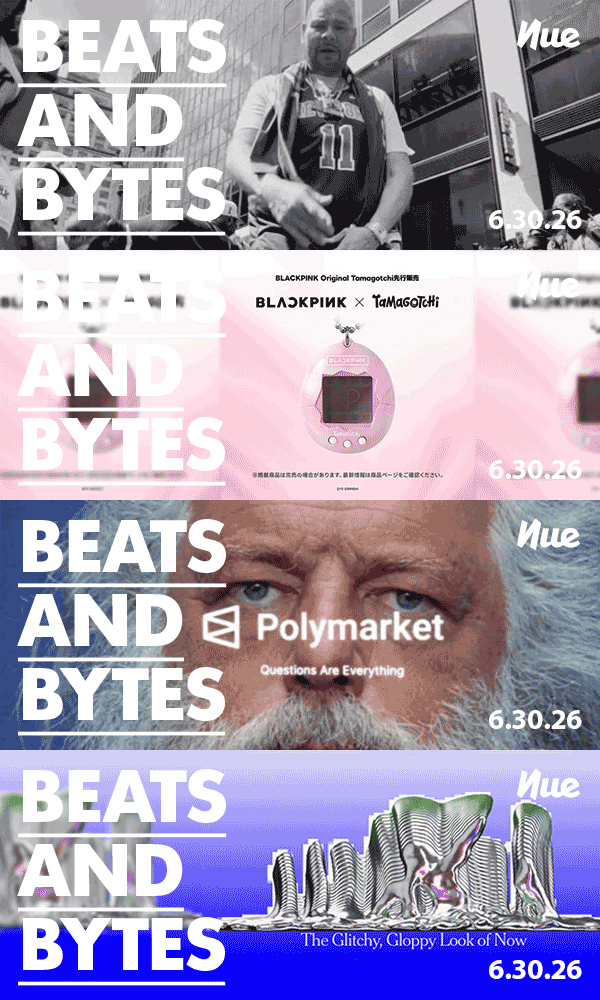
BEATS + BYTES HALFTIME REPORT
The Trends Defining Music, Culture & Brand Marketing in 2026
July 1st marks halftime of 2026. What a disruptive year it’s been. I touched on it in Q1’s recap.
But in Q2, the era of great transformation is only accelerating, and success increasingly comes from a blatant disregard for the old way of doing things.
There is more noise than ever before. More content, more platforms, more creators, more opinions. But there has also never been more opportunity.
Our goal with Beats + Bytes is to connect the dots and help you see where culture is heading next.
TL;DR — FIVE TAKEAWAYS FROM THE FIRST HALF OF 2026
- The music business has a new music problem.
- AI isn’t replacing creativity.
- It’s expanding who gets to participate.
- Fandom is becoming more participatory IRL experiences are the counterforce to AI and digital overload.
- Culture is becoming the most valuable intelligence layer in business.
PART I — THE BIG RESET
New Music
The music industry is having a big problem when it comes to breaking new music.
New music has always been the lifeblood of the industry. But that is currently not the case. This might be the biggest problem and opportunity in front of the music business.
According to Luminate, music listeners ages 13 to 24, arguably the industry’s most important and heavily targeted audience, are increasingly embracing music from the 1990s and earlier, while the number of listeners who say music from the 2020s is their favorite continues to decline.
Catalog
Meanwhile, catalog remains one of the biggest opportunities in music, representing roughly 65% of recorded music streaming revenue.
There are many reasons the catalog business is thriving while new music struggles. Familiarity, nostalgia and algorithms all play a role.
Every catalog may also have a new life in AI. With the proper laws and guardrails in place, established music could be headed for an even bigger boom.
This is the start of what I’m calling the Living Catalog. Where old music can keep generating new value instead of just sitting on a shelf.
Streaming
We are closing in on a billion subscribers to music streamers globally. That’s amazing.
But how many more subscribers can these platforms realistically add?
It’s clear we are approaching market saturation, which opens the door to an entirely new era of music formats and monetization.
Exclusives
When a subscription market saturates, one of two things happens.
Either platforms consolidate and economics trend downward for creators, which is bad.
Or a new layer of distribution appears and platforms start competing again for premium content that differentiates them, which is good if you happen to own the premium content.
Every other content vertical including film, television, sports, gaming and long-form audio already sells premium exclusives to drive subscriber growth.
Music is the last vertical that doesn’t.
The infrastructure layer always moves before the cultural layer does, and the people who notice the infrastructure first get to price the culture that rides on top of it. It’s the cable-plus-media wave of the 1990s happening again in fast forward, and the music business is standing on the beach arguing about playlist placements and chasing data-driven A&R when the next cycle is being built, above our heads, by four companies, with our product nowhere in their strategy decks.
Mark Gillespie said it best in this piece that changes, the moment the first major album is windowed exclusively through one of them.
PART II — AI CHANGES EVERYTHING
AI Music
AI isn’t replacing creativity. It’s enhancing it.
AI is a creative tool.
As guardrails come into place to protect artists’ IP, this could be one of the biggest growth moments in the history of the music business.
Fan Remixes
The best marketing ideas are the ones that are shareable. The best songs are increasingly becoming the ones that can be interpreted.
Everyone wants to make the experience their own.
In the AI era, songs become platforms.
The next hit song won’t just be streamed. It will be remixed millions of times by fans.
Songs are evolving from static pieces of art into living creative systems that can be personalized, localized, memed, covered and endlessly reimagined.
In this Living Catalog era, music never finishes being made, whether it’s a new release getting remixed in real time or a decades-old song getting a second life through AI.
“Songs are evolving from static pieces of art into living creative systems.”
Success in the streaming era was measured by plays. Success in the generative era may be measured by participation.
“It’s no longer enough to hear the song. Fans want to be in it.”
For brands, who already spend millions borrowing music’s cultural value, the next opportunity is turning that spend into remixable IP: one brand sound, many versions, many creators, many markets. That way, the campaign does not have to end when the media spend stops.
Royalty Free Music
As the creator economy booms and AI starts dominating content creation, allowing for infinite iterations, clearing music at scale becomes a major issue.
Music unquestionably makes every podcast, campaign and social post better.
The data shows campaigns with audio outperform those without on profit (+75%), trust (+81%), price insensitivity (+81%) and customer acquisition (+19%). Across 14 measures, the average uplift for campaigns featuring audio was 22%.
Audio nearly doubles the profit generated by emotionally driven campaigns, especially when paired with distinctive brand assets and deployed consistently over time.
Yet many people are still doing it illegally and exposing themselves to fees, fines and takedowns.
Royalty free music is the gateway drug for more brands to build sophisticated music strategies.
Music Intelligence
We are living through an unprecedented era of intelligence and insights.Music is the dominant cultural force and a true intelligence layer that informs both strategy and storytelling. This isn’t about A&R and it isn’t just about data. It’s about insight that sharpens every pitch and gives brands a clear edge. Those insights come from representing artists at scale, understanding where to pull proprietary and aggregated data sources and having cultural experts flying high around the hoop, as brands build their campaigns.
PART III — FANDOM IS BEING REWRITTEN
Super Fans
One of the biggest challenges facing the music industry over the past five years has been figuring out how to better tap into the super fan.
Brick by brick, it’s getting solved.
How do you create a more direct relationship with your fans? There are now some very good case studies showing where things are headed.
The Fan Footage Is What Counts
Your concert experience is almost irrelevant.
It’s the footage that counts. The proof that you were there.
“Piss and shit can’t be smelled through the screen, after all.”
SWSH just hit the scene and they seem to have a strong vision here. So does Greenfly in sports.
Music is the holy grail for fan content. Whoever aggregates it holds tremendous power.
Hip Hop
The aging hip hop stars are becoming some of the most important voices and commentators across sports, culture and politics.
These are great storytellers finding new lanes. Fat Joe, Jadakiss, Cam’Ron, Mase and Snoop are all aging incredibly well as the new broadcasters of our time. In the process, they are making their music more culturally relevant than ever.
Meanwhile, the data around next generation of hip hop is equally fascinating as Rage Rap and Brazilian & Russian Phonk & Detroit Rap dominate younger audiences.
“Hip hop isn’t aging. It’s expanding.”
Music Videos
Music videos are more important than ever.
Brands started rolling out music videos in a major way this year and they are producing meaningful results, from GAP to Cheetos. These projects are taking brands into entirely new lanes.
Beyond that, music videos remain essential for artists. I still wish YouTube had its own version of New Music Friday for videos.
I connect to new songs much more deeply these days, when I can see them.
Longer form, high concept videos are popping up more and more in a way to combat TikTok’s short adrenalin bumps.
Meanwhile, creativity is booming. Everywhere you go can be the set of a new video. I’m marveling at how Fat Joe and acclaimed producer Eif Rivera pulled this off Victory Lap while being smack in the center of the craziness of the Knicks Championship parade.
MTV
As Paramount merges with Warner, it’s clear that MTV is not currently a priority.
But it should be. TRL. MTV Jams. Yo! MTV Raps. Spring Break.
These weren’t just television shows. They were cultural institutions.
Given today’s political climate, I understand why prioritizing CBS Sunday Morning makes sense. But the Ellison’s are sitting on a gold mine.
MTV, VH1 and BET were cash cows back in the day. These brands tap directly into nostalgia and, in many ways, could be more relevant than ever.
If Paramount doesn’t want to fully invest in MTV, they should set it free from its shackles and let someone else seize the opportunity.
If I had the keys, I’d bring MTV back as a live, culture-first brand built around moments, not a linear channel. Picture TRL for the algorithm era.
Viewing Party Culture
As ticket prices continue climbing to astronomical levels, if you can’t make the big dance, the viewing party is becoming a compelling option.
In many cases, it may actually be the better experience.
Who wants to deal with traffic and crowds?
The experience keeps getting better as companies like COSM prove the concept and announce expansion.
PART IV — IRL STRIKES BACK
IRL
IRL is the gravitational force that counters AI and the digital world. As screen time continues to accelerate, there is an equal and opposite push to get off the phone, get into the real world and connect.
Experiences are more important than ever.
You can see it everywhere across culture. From Jay-Z opening an epic, underground pop-up to sell merch, to pints of ice cream sales declining while lines form around the block for every new ice cream spot in New York.
People don’t just want ice cream anymore.
They want the experience.
Live
The pie is growing.
There are more artists touring globally than ever before and that number continues to increase. International growth may now be outpacing the United States. Latin America is on fire and many believe that growth will continue for years to come.
Despite all the concerns around pricing and consumer fatigue, the live business continues to thrive.
Blue Dot
There was a quick burst of hype around the term Blue Dot this quarter, but I think much of it was media hyperbole.
The media loves a new buzzword.
Ticket sales continue to perform well and the live business remains healthy.
Sports & Fandom
Sports remains one of the last true water cooler moments where everyone can come together and experience something in real time.
Sports are incredibly hot right now.
Beyond the game itself, the appetite is there and the cross section is where much of the opportunity lies. Music and Sports is a 1+1=11 opportunity.
Fan experiences, galleries, fashion collaborations, performances, soundtracks and side events surrounding the main event are increasingly becoming as important as the game itself.
Peak New York
Maybe I’m biased because I sold my place in Miami and moved home. Maybe not.
But New York feels different right now. From the Knicks to the World Cup, from Jay-Z’s Yankee Stadium campaign to Taylor Swift celebrating at MSG this weekend, the energy in New York is unlike anything I’ve seen in years.
There is a sense of unity and excitement in the air that can only be understood if you’re here experiencing it. I’ve seen it first hand for months. Anybody talking about New York that isn’t here, don’t know diddly. Period.
PART V — MEDIA, BRANDS & CONTENT
Content
“Virality is over. It’s the new table stakes.”
Consistency is what matters.
Clipping took off and was exposed with Chaotic Goods. Micro drama is beginning to explode. Jeffrey Katzenberg’s thesis was right. The timing was just wrong. Luck is always a factor.
In 2026, who wants to watch 60 minutes when you can watch sixty one-minute hot takes?
R. Kelly also had it right with Trapped in the Closet. That one didn’t age particularly well.
With attention spans where they are today, and the social graph being the dominant force multiplier in relevance, this category is going to explode.
Creators
I know the prevailing opinion is that we are still in the early innings of the creator economy.
It’s remarkable that Dhar Mann and IShowSpeed have larger audiences than all of the traditional media companies.
And while I love the rise of the nano expert, as everyone rushes toward creator marketing, I actually find it becoming less interesting.
“Creators can’t hold a candle to true stars.”
Musicians remain the ultimate creators whose art can transcend culture at the speed of sound.
As everyone coming back from Cannes is singing the praises of the mass influx of creators, my belief is that the creator economy will eventually lose some of its luster as audiences attention returns to people with exceptional artistic and storytelling ability.
Newsletters
There are so many freaking emails right now.
We may be approaching the end of the long written email.
Substack has done a great job of helping writers build off each other’s audiences, and that is crucial in today’s environment.
But as everyone launches a newsletter, the category is becoming diluted.
Remember app saturation?
It’s beginning to feel like that.
Reinvention is coming and it’s going to happen quickly.
My bet: the newsletters that survive will feel more like a relationship than a publication. They need to be interactive, personalized and meet the readers where they are at… which is less and less in a crowded inbox.
Spotify
Spotify continues to define the times.
Their latest announcements tell an important story.
They’re trying to solve ticket scalping by offering superfans early access to tickets through partnerships with Live Nation. They’re going deeper into livestreaming. And their new tagline, “Time Well Spent,” really resonates in a world where time & attention are the most important commodities we have.
When was the last time you had a bad time listening to music?
Brands
Brands are increasingly becoming media companies.
Bose announced its media strategy this week. Pharrell is recording albums inside his office at LVMH and premiering them on the runway. GAP hired a Chief Entertainment Officer and has become one of the year’s great turnaround stories. Coke launched a label. Havas launched their own label too.
The fluency between culture, entertainment & brands is becoming invaluable.
PART VI — FOLLOW THE MONEY
Prediction Markets
With more than $400 million in music bets placed on Polymarket so far this year, prediction markets represent a huge opportunity for the music business.
That’s not including what’s happening on Kalshi and META’s new product which could have a significant impact with women betting. Honestly, these platforms are in desperate need of a holistic music strategy rather than fake influencer payments. It was a good start with the new Rick Rubin commercial but the platforms require so much more strategic help and if done right, can be a real boom for the music business and prediction markets alike.
Consolidation
Consolidation is happening everywhere across music, media and brands. Universal acquires Downtown.
Penske acquires a collection of Vox Media’s music & culture brands.
Scale continues to matter.
As industries mature, consolidation follows.
IPOs & Activists
We are headed into a major IPO boom.
The success of SpaceX is going to create tremendous energy and attention in the capital markets.
This will become one of the biggest business and marketing stories of the second half of the year. Eleven Labs is coming. So is Bending Spoons.
At the same time, activist investors are increasingly looking for undervalued assets where they can come in and create stronger companies.
Even when activists don’t win, their ideas often resonate and force companies to rethink what is possible.
PART VII — WHAT’S NEXT
New Aesthetics
Remember when Red Antler and Gin Lane defined an era in branding?
Some would argue they still do.
But today, the hottest branding agencies in the world might be Claude, ChatGPT and Canva. The aesthetic of the moment feels glitchy, whimsical and maximalist.
A new visual language is emerging in real time.
Digital Goods
Most people have run the other way.
But the signals suggest this category is very real, especially at the intersection of physical and digital ownership.
From BlackPINK’s sold out Tamagotchi-inspired digital pets to digital music trading cards, the space continues to evolve.
Music remains uniquely positioned to bridge the physical and digital worlds.
Movies
Music is making a huge mark in film in 2026.
The Michael Jackson movie is breaking all sorts of box office records. Taylor Swift dropped the lead single for Toy Story 5 and her marketing rollout has been nothing short of brilliant.
Tribeca this year also told so many great music stories.
But the most interesting trend in Hollywood right now is that a new generation is disrupting the old guard.
The barriers to entry and the budgets once required to make meaningful work are disappearing.
Shot on iPhone
There is also a growing wave of movies, documentaries and premium content being shot entirely on phones.
Filmmaking is becoming dramatically more accessible.
“The power is no longer in the equipment. The power is in the access and the edit.”
CLOSING THOUGHTS
The common thread across all of these trends is simple.
Culture is fragmenting & becoming personalized. Technology is accelerating. Human connection is becoming more valuable, not less.
The winners over the next decade won’t be the people with the biggest budgets or the largest audiences.
They will be the people who understand culture, embrace new tools and build authentic relationships with communities.
“Music is an emotional enhancement layer that sits across all of it.”
As always, if you’re looking to better understand where culture is heading, or how these shifts impact your business, we’d love to talk.
If you’re a brand, platform, or artist team trying to figure out your music strategy for the back half of the year, this is exactly the kind of problem we want to help solve.
The second half of 2026 is going to be wild — and the people who win it will be the ones who moved while everyone else was still arguing about playlist placements.