Q1 Just Rewired Culture
We can throw Q1 in the bag.
From CES to Sundance; the Super Bowl to the WBC; the Grammys to the Oscars; and now SXSW to Winter Music Conference, the calendar has been packed with cultural checkpoints.
Awards were handed out, deals were signed, and a lot of handshakes happened in hotel lobbies and members’ clubs.
But beneath the ceremonies, deeper shifts have been taking shape across music, media, tech and brands.
Culture is reorganizing itself around three forces: live experiences, intelligent machines, and brands behaving more like entertainment companies.
Once you see it, you see it everywhere.
Live Is Where the Money Is
Few people understand the current landscape as clearly as Ari Emanuel.
While much of Silicon Valley is racing toward fully digital futures, Ari has been quietly assembling the opposite. TKO continues to grow around sports and spectacle. WME remains the connective tissue of entertainment and talent. Now, his new venture MARI is positioning itself around IP and experiences.
It’s a fascinating counterbalance to the AI boom.
When the world becomes more digital, scarcity moves to the physical world and being in the room becomes more valuable than watching the feed.
From festivals to conferences to awards shows, the live ecosystem is expanding rapidly. Venues, production companies, ticketing platforms, hospitality groups, and brand sponsors are becoming some of the most strategic businesses in entertainment.
Several investors I spoke with during Q1 repeated the same idea: If the internet becomes infinite, attention concentrates around real-world moments.
The brands that understand this are no longer simply sponsoring events, they’re building their own. That’s what Taco Bell & Snapchat did this quarter.
Agents vs Agentics
The word of the year so far might be “agentic.”
Creators are starting to treat AI agents like collaborators. Some manage workflows while others generate content. A few are operating like personalities that live alongside their human counterparts.
This is where the Clawbot movement begins to get interesting.
If an artist can deploy a network of AI agents to help create music, manage community, negotiate opportunities, and generate content, it raises a very uncomfortable question for traditional middlemen: What happens when the machine does part of their job?
Talent agents remain some of the most powerful operators in culture, but even they are beginning to confront a shift in identity. Can the most valuable, most trusted consultant on the team actually be digital?
The next era of the internet may not be platform driven or creator driven, it may be agent driven. Ironically, someone like Ari Emanuel seems prepared for that future because he is focused on controlling experiences and IP rather than sticking to digital distribution.
Specialists Are Needed To Run These Plays
One of the most interesting hires of the quarter came from Gap when they appointed a Chief Entertainment Officer.
Ten years ago that title would have sounded strange inside a retail organization, but today it feels inevitable.
Gap has once again begun lighting up the market with commercials, partnerships, and culture-driven storytelling. The brand suddenly feels alive in a way it has not for years. Their new video with Young Miko is something every brand marketer needs to see. Even the behind-the-scenes videos are gaining brand traction.
The lesson is simple: If a company wants to participate in culture, it needs someone inside the organization who understands talent, deal making, measurement, and data-driven decisions.
Taste still matters, but taste combined with data is even more powerful.
Most companies are still treating culture like a campaign, while the winners are treating it like a capability.
Big Is Bigger
The consolidation story continues.
Live Nation’s relationship with Ticketmaster survived intense scrutiny, although the state AG’s may still have something to say about the less-than-savory DoJ settlement. Universal Music Group continues to quietly acquire assets and capabilities across the music ecosystem. The majors now have meaningful stakes in large portions of the emerging AI music landscape. And the Paramount-Warner merger represents another major reshuffling moment.
As the current administration cozies up to consolidation, every company in entertainment faces the same strategic question: Do you scale up or do you specialize? Go big or go boutique?
The middle of the barbell is becoming harder to maintain.
Is Indie Dead?
The independent spirit in music is alive creatively, but the infrastructure around it is changing. Distribution platforms are being absorbed by larger companies, services are being bundled into bigger ecosystems, and the economies of scale are becoming harder to ignore.
Solo entrepreneurship has never been more culturally celebrated, but operating a small shop without leverage or partnerships is becoming more difficult.
The next wave of independence may not look like lone wolves, it may look more like networks.
Jingles Are Singles
Brand collaborations in music have become more sophisticated this year.
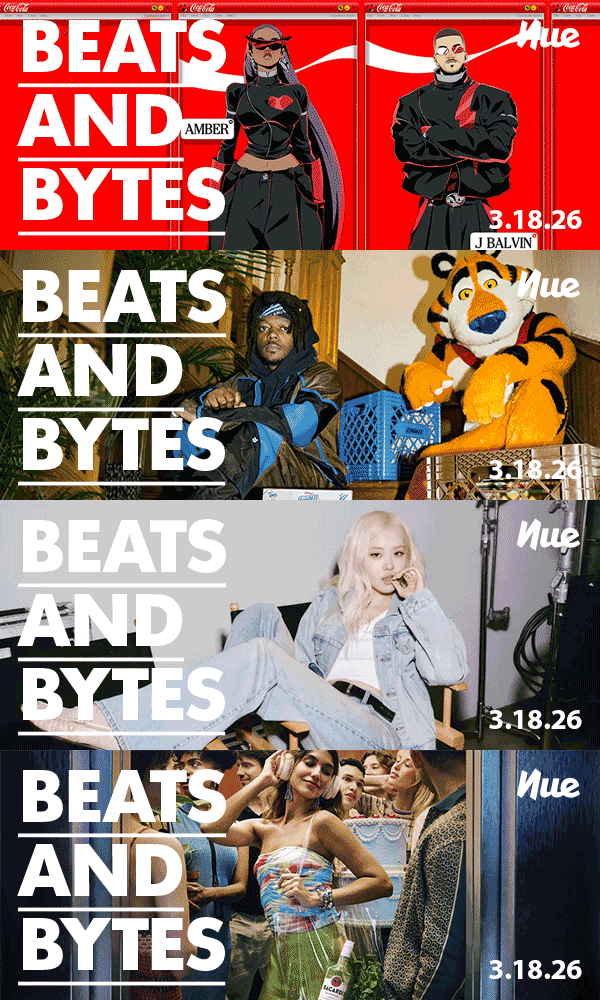
One of my favorite examples is JID’s collaboration with Frosted Flakes. What could have easily been a novelty campaign turned into a full-on cultural moment. The partnership produced a track on Spotify, a merch drop for hypebeasts, and a custom cereal box for the day ones.
T-Pain partnering with Buffalo Wild Wings is another good example of a collaboration leading to an album release of product-related tracks.
And Coke launching its World Cup anthem shows how global brands are beginning to treat music as core storytelling infrastructure rather than background marketing.
These collaborations are no longer just advertisements, they’re cultural artifacts.
The Medium Is The Message
New short-form genres are emerging faster than ever.
Phonk has exploded across TikTok and YouTube, and music creators on TikTok are effectively writing the new generation of jingles for brands as big as Dr Pepper. Even PetSmart is getting in on the action.
Film and television are reshaping music discovery with Netflix projects creating breakout musical moments and A24 redefining how musicians appear inside films.
Protest songs might even be back, if Jesse Welles is any indication. Every platform now has its own ecosystem, its own stars, and its own way of breaking them.
New Breakout Content Formats
New formats are producing entirely new personalities.
Jack from Trackstars is becoming a breakout voice in music commentary while Twitter livestream shows and formats like Rushmore are gaining traction.
Lil Dicky and Benny Blanco’s new reality-style interview show is another fascinating example. The Ed Sheeran episode highlights the concept perfectly. It feels like an intimate conversation, a casual hang, and an amazing music creation moment all at once. Even the commercials are true to their voice and vibe.
Now, the hit Insta page Agents vs Assistants is turning into a hot brand with an award show and daily livestreaming show.
Microdrama’s Chinese streaming platforms are fully interactive. Brands & creators are taking notice here, too.
In the era of short-form video, newsletters and podcasts, audiences seem to be gravitating toward content that feels more authentic and less polished. Artists used to release songs, but now they launch universes.
Prediction Markets Write History
This may be the most controversial cultural trend of the year.
Prediction markets are beginning to shape how audiences watch major cultural events.
Just as sports betting injected enormous energy and attention into sports viewership, prediction markets are beginning to influence how people engage with the Super Bowl, the Grammys, and the Oscars.
In this moment, where the space remains relatively unregulated, the opportunity is enormous.
There’s a reason many young financial quants are choosing to build companies in this sector rather than heading to Wall Street. Culture is becoming a tradable asset class.
Nostalgia
Nostalgia continues to be one of the most powerful creative engines in culture.
The new Sprite tagline feels like a modern reinterpretation of the original. Ray-Ban released a beautiful commercial paying homage to the film, Belly. Even opera is beginning to influence fashion and music aesthetics again.
Although never-been-done-before is always exciting, there’s comfort in what we already know and prudence is often doing what works.
New Tech Stunts
Everywhere you look, companies are searching for the next cultural spectacle.
Holographic drone shows are appearing to promote album releases. Build-a-thons like ClawCon are becoming new creative gathering spaces. Livestream spectacles are blending entertainment and commerce. Live shopping continues gaining traction. Music hype houses are experimenting with collaborative formats. Music quiz shows are finding new life across digital platforms.
It’s still too early to know which of these formats will stick, but experimentation is clearly accelerating.
2025 was the biggest year in the history of recorded music. 2026 is looking bigger on all fronts, and it’s only Q1.
Coachella, Cannes, The Upfronts and the World Cup build up are still ahead in Q2.
If the first three months of the year are any indication, the pace of culture is only accelerating as the tools get more exponential.
Here is a list of the biggest songs from Q1.
And here is a list of some of the major deals that have happened so far in music this past year.
I’ve been unpacking some of these ideas in a few recent conversations—on The Music Biz Weekly Podcast and FYI AI—digging into AI’s role in music, what responsibility looks like in this next phase, and why consistent dialogue is becoming a creative advantage.